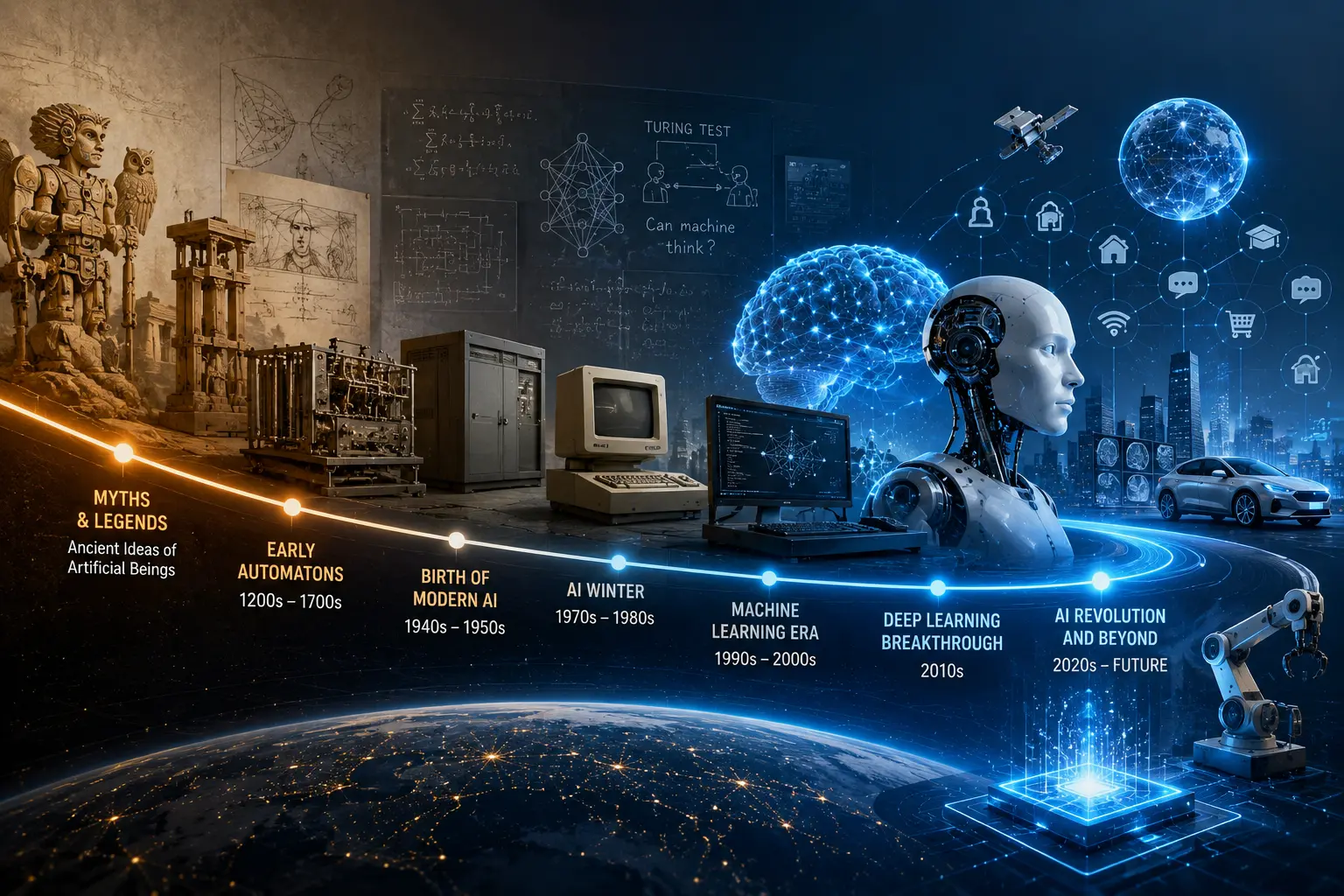
Artificial Intelligence is everywhere today. It writes emails, drives cars, detects diseases, and even talks back to us through phones and speakers. But have you ever wondered where Artificial Intelligence actually came from? Who created it, and why did it become such a big part of human existence? This article takes you through the full history of Artificial Intelligence, from ancient myths to the powerful systems we use in 2026. By the end, you will understand how Artificial Intelligence grew from a simple idea into one of the biggest revolutions in human history.
What Is Artificial Intelligence?
Artificial Intelligence, often called AI, is the science of making machines think and act like humans. It allows computers to learn, reason, and make decisions without constant human help. Artificial Intelligence is not just one tool. It is a wide field that includes machine learning, natural language processing, robotics, and computer vision.
In simple words, Artificial Intelligence lets machines do tasks that once needed human brains. This includes recognizing faces, understanding speech, translating languages, and even creating art. The existence of Artificial Intelligence has changed how we live, work, and communicate.
The Ancient Roots: Before the First AI Existed
Many people think Artificial Intelligence started in the 1950s. But the dream of intelligent machines is much older. The idea of Artificial Intelligence can be traced back over 2,000 years to ancient Greek mythology.
In Greek stories, the god Hephaestus built mechanical handmaidens out of gold. He also created Talos, a giant mechanical guardian. These myths show that humans have always dreamed about creating thinking machines, long before real technology existed.
Later, around 250 BC, an inventor named Ctesibius built the world’s first self-regulating machine, a water clock. This was not Artificial Intelligence in the modern sense, but it was an early step toward automated systems. The history of AI truly begins with this long human curiosity about machines that could think and act on their own.
Who Created Artificial Intelligence? The True Story
The real foundation of Artificial Intelligence as a science was laid by a British mathematician named Alan Turing. In 1950, Turing published a paper called “Computing Machinery and Intelligence.” In this paper, he asked a simple but powerful question: “Can machines think?”
Turing also created the famous Turing Test. This test checks if a machine can have a conversation so naturally that a human cannot tell if they are talking to a machine or a person. This idea became one of the earliest benchmarks for measuring Artificial Intelligence.
However, the actual term “Artificial Intelligence” was coined later by a computer scientist named John McCarthy. In 1956, McCarthy organized a summer workshop at Dartmouth College in the United States. This event, known as the Dartmouth Conference, is officially recognized as the birth of Artificial Intelligence as a formal field of study.
McCarthy described Artificial Intelligence as the science of making intelligent machines. He believed computers could one day think, reason, and solve problems just like humans. Along with McCarthy, other key figures like Marvin Minsky, Claude Shannon, and Nathaniel Rochester also helped shape the early direction of Artificial Intelligence.
Why Was Artificial Intelligence Created?
Artificial Intelligence was created to solve a basic human problem: machines could calculate fast, but they could not think, learn, or adapt. Researchers wanted to build systems that could reason like humans, learn from experience, and solve complex problems without being told every single step.
The goal behind the creation of Artificial Intelligence was simple yet ambitious. Scientists wanted machines that could:
- Understand human language
- Recognize patterns and images
- Make logical decisions
- Learn from data and experience
- Solve problems without constant human input
This vision is what pushed the entire revolution of Artificial Intelligence forward, even during difficult periods when progress slowed down.
The Journey Through Decades: How Artificial Intelligence Evolved
The history of Artificial Intelligence is not a straight line. It went through exciting breakthroughs and also long periods of slow progress, often called “AI Winters.” Let’s walk through the major decades that shaped this revolution.
The 1950s: The Birth of an Idea
This decade marked the true beginning of Artificial Intelligence. Alan Turing introduced his groundbreaking concepts, and John McCarthy coined the term at the Dartmouth Conference in 1956. In 1958, McCarthy also created LISP, a programming language still used in some AI research today. Early programs could play checkers and solve basic logic problems, showing that machines could indeed “think” in a limited way.
The 1960s and 1970s: Early Excitement and the First AI Winter
During this time, researchers built early chatbots like ELIZA, which could mimic human conversation. Scientists were extremely optimistic. Some even predicted that machines would reach human-level intelligence within a decade.
However, computers at that time lacked the processing power needed for real Artificial Intelligence. Funding dried up, and progress slowed sharply. This period became known as the first AI Winter, a time when interest and investment in Artificial Intelligence dropped significantly.
The 1980s: Expert Systems and Renewed Hope
Artificial Intelligence found new life through “expert systems.” These were programs designed to solve specific problems in fields like medicine and engineering by following expert-created rules. Businesses started using Artificial Intelligence for narrow but useful tasks, bringing fresh investment back into the field.
The 1990s: Machines Start Beating Humans
This decade gave Artificial Intelligence its first major public victory. In 1997, IBM’s Deep Blue defeated world chess champion Garry Kasparov. This moment proved that Artificial Intelligence could outperform even the smartest humans in specific tasks. It marked a shift from simple rule-based systems to smarter, statistical learning methods.
The 2000s: The Rise of Big Data and Machine Learning
As the internet grew rapidly, massive amounts of data became available. This data fed a new wave of Artificial Intelligence research called machine learning. Instead of following fixed rules, machines began learning patterns directly from data, making them smarter and more flexible.
The 2010s: Deep Learning Changes Everything
This decade brought a huge revolution in Artificial Intelligence through neural networks and deep learning. In 2012, a system called AlexNet proved that deep learning could outperform older methods in recognizing images. Soon after, Artificial Intelligence entered everyday life through voice assistants like Siri and Alexa.
In 2016, Google’s AlphaGo defeated world champion Lee Sedol in the ancient game of Go, a game far more complex than chess. This was seen as proof that Artificial Intelligence could master intuition-based thinking, not just pure calculation.
The 2020s: Generative AI Takes Over
This is when Artificial Intelligence became a household name. The release of powerful language models allowed machines to write essays, generate images, and hold human-like conversations. Generative Artificial Intelligence exploded in popularity, and tools became accessible to everyday people, not just scientists and engineers.
Artificial Intelligence in 2026: Where We Stand Today
The revolution of Artificial Intelligence has reached a massive scale in 2026. The numbers show just how deeply Artificial Intelligence has spread into business and daily existence.
- The global Artificial Intelligence market is expected to generate around $514 billion to $600 billion in revenue in 2026, depending on the source and measurement method.
- About 94% of companies worldwide now use Artificial Intelligence in at least one business function.
- Over 1.3 billion people worldwide are actively using Artificial Intelligence tools, which is roughly 16% of the global population.
- Popular AI chatbots have reached hundreds of millions of weekly active users, showing how mainstream Artificial Intelligence has become.
- Global corporate investment in Artificial Intelligence reached well over $580 billion in the past year alone, according to Stanford’s AI Index Report.
These numbers show that the revolution caused by Artificial Intelligence is not slowing down. It is accelerating across healthcare, finance, education, retail, and almost every other industry you can think of.
How Artificial Intelligence Revolutionized Different Industries
The impact of Artificial Intelligence is visible across nearly every part of human existence. Here is how this revolution shows up in real life:
Healthcare
Artificial Intelligence helps doctors detect diseases earlier through image analysis. It speeds up drug discovery and supports personalized treatment plans. The AI in healthcare market is growing rapidly, showing strong year-over-year growth as hospitals adopt smarter diagnostic tools.
Business and Customer Service
Companies use Artificial Intelligence chatbots to answer customer questions instantly, day or night. This reduces costs and improves customer satisfaction at the same time.
Transportation
Self-driving technology relies heavily on Artificial Intelligence to recognize roads, pedestrians, and obstacles. While fully autonomous cars are still developing, AI-assisted driving features are already common in many vehicles.
Education
Artificial Intelligence powers personalized learning platforms that adjust lessons based on a student’s pace and understanding. This makes education more accessible and effective for different types of learners.
Creative Fields
From writing assistance to image generation, Artificial Intelligence has entered creative industries too. Designers, writers, and marketers now use AI tools to speed up their workflow, though human creativity still guides the final result.
The Pros and Cons of Artificial Intelligence
Like any major revolution, Artificial Intelligence comes with both benefits and challenges.
Advantages of Artificial Intelligence
- Saves time by automating repetitive tasks
- Improves accuracy in fields like healthcare and finance
- Works continuously without getting tired
- Helps analyze huge amounts of data quickly
- Creates new jobs and business opportunities
Challenges and Concerns
- Job displacement in certain industries
- Privacy and data security concerns
- High costs of developing advanced systems
- Risk of bias if trained on unfair data
- Ethical questions around decision-making by machines
Experts agree that responsible development is key. The future of Artificial Intelligence depends on balancing innovation with safety and fairness.
The Future of AI: What Comes Next?
So, what does the future of AI actually look like? Researchers and industry leaders have different opinions, but a few trends are becoming clear.
Many experts believe the next major shift is “agentic AI,” where systems do not just answer questions but take actions on their own, like booking tasks, managing workflows, or running entire processes with little human input. Gartner predicts that a large share of business applications will include this kind of AI feature by the end of 2026.
There is also a lot of discussion about Artificial General Intelligence, or AGI. This means a machine that can think and reason across many areas, just like a human. While some industry leaders once predicted AGI by 2026, most current expert surveys and prediction markets now place a stronger probability of major AGI milestones sometime between 2028 and the 2030s.
Whatever happens, one thing is certain. The future of AI will continue to shape jobs, economies, and daily existence in ways we are only beginning to understand.
Conclusion: Understanding the True History of Artificial Intelligence
The history of Artificial Intelligence is a story of human curiosity, ambition, and constant improvement. From ancient Greek myths to Alan Turing’s groundbreaking questions, and from John McCarthy’s Dartmouth Conference to today’s powerful AI tools, this journey shows how far human innovation can go.
Artificial Intelligence was created to help machines think, learn, and solve problems like humans. Today, it touches almost every part of our existence, from healthcare and business to education and entertainment. The revolution caused by Artificial Intelligence is still unfolding, and its future promises even bigger changes.
If you want to stay ahead in this fast-changing world, understanding the roots and growth of Artificial Intelligence is a great place to start. The story of Artificial Intelligence is far from finished, and we are all witnessing its next chapter unfold in real time.