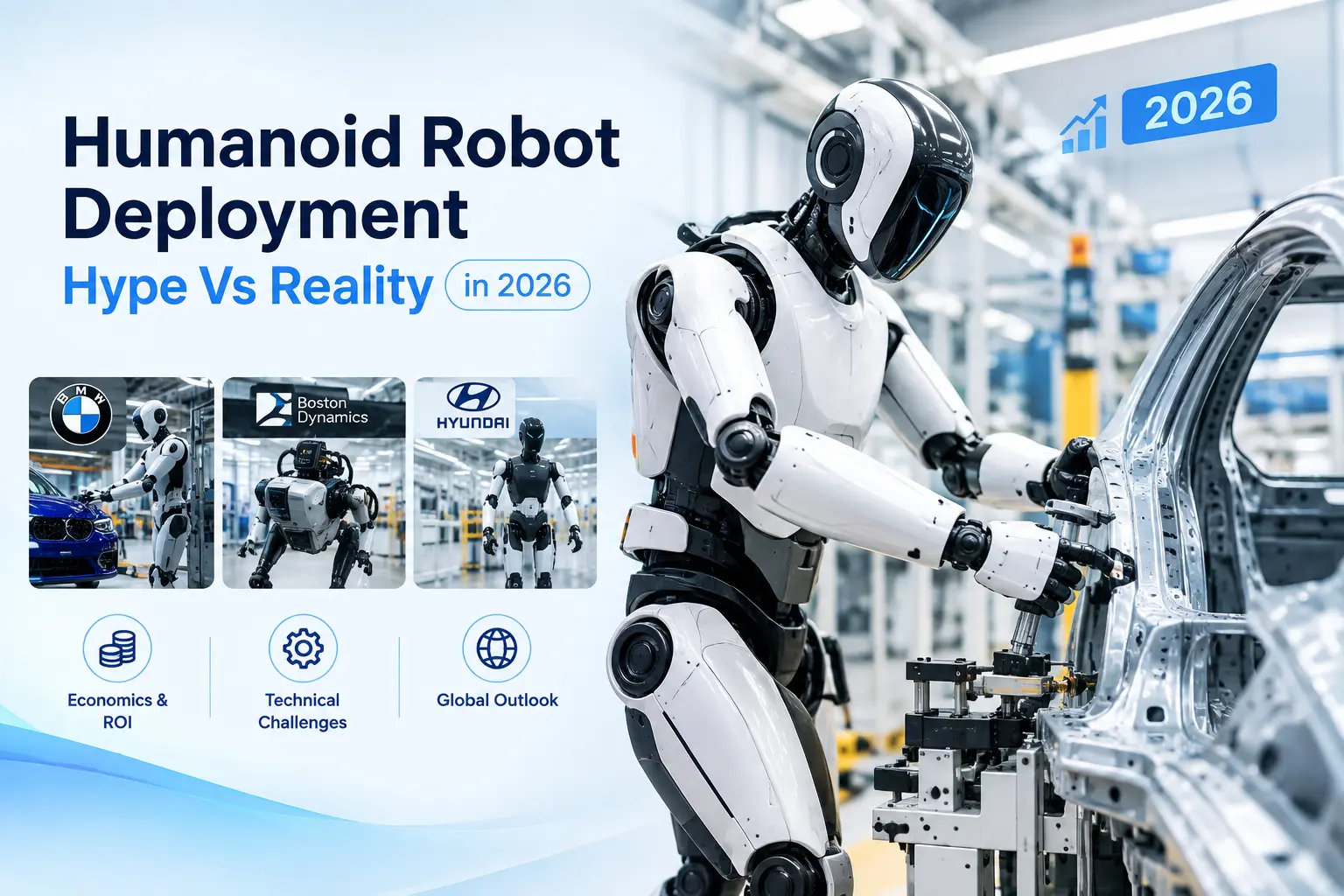
The Dawn of True Humanoid Robot Deployment
Humanoid robot deployment is reshaping modern manufacturing in 2026. For years, the public only saw highly choreographed demo reels. Robotics companies promised a massive revolution in industrial manufacturing. Now, we are witnessing genuine factory pilot programs globally. This article separates industry hype from actual verifiable production reality. It is time to look closely at humanoid robot deployment. Major automotive players like BMW and Hyundai lead this charge. They are proving that these machines can perform real labor. However, verified deployment numbers remain much lower than headline claims. We must examine the actual data behind these new workers. This new era is not just about cool internet videos. It is about measurable returns on investment and cycle times. Factory managers want machines that hit strict production quotas daily. They do not care about backflips or viral social media. They only care about consistent performance on the assembly line. We are finally getting real data from these factory floors. The truth is both incredibly exciting and surprisingly grounded today. The robotics industry is experiencing an incredible transformation right now. Engineers are pushing boundaries further than anyone previously thought possible. This progress brings incredible opportunities for early technology corporate adopters. However, this space also brings significant financial and operational risks.
Separating Headline Hype From Actual Reality
The internet is flooded with claims of millions of robots. The actual humanoid robot deployment numbers tell a different story. Global production of humanoids reached roughly 20,000 units in 2025. This was a massive tenfold increase from the previous year. However, the vast majority were not used for real work. About ninety percent went to research, data collection, and entertainment. Only ten percent saw actual real-world commercial application deployment. That means barely 2,000 robots entered genuine workforce roles worldwide. Most of these real-world projects were small proof-of-concept tests. Many were heavily driven by government subsidies and strategic investments. The market still lacks widespread, large-scale commercial deployments today. Headline claims often blur the line between prototypes and products. A successful lab test does not guarantee assembly line success. Real factory environments are chaotic, unpredictable, and highly demanding. Robots must handle endless repetition without suffering hardware failures. Projections suggest up to 60,000 units could deploy this year. Yet, true mass adoption is still several years away. Industry experts believe a commercial inflection point is approaching slowly. Until then, we must view massive deployment claims with skepticism. Investors must look past flashy marketing to find true value. The difference between a controlled demo and reality is vast. Factories do not forgive fragile hardware or bad software code. Only the most robust machines will survive real industrial deployment.
Figure’s Robot Hits the BMW Assembly Line
BMW is setting the standard for humanoid robot deployment. They recently published unprecedented production-validated data from their plants. This involves their collaboration with Figure AI at Spartanburg. Figure 02 robots were integrated into active automotive manufacturing lines. This was not a brief test or a staged demonstration. Six humanoid robots worked full ten-hour shifts, five days weekly. They operated directly on the active BMW X3 assembly line. Their task involved handling heavy, cumbersome sheet metal parts precisely. The robots loaded more than 90,000 parts during the pilot. They worked across 1,250 operational hours without major disruptions. These robots maintained a placement accuracy exceeding ninety-nine percent. They consistently met the strict eighty-four-second cycle time target. The robots picked parts and placed them with five-millimeter tolerance. Six-axis industrial robots then seamlessly welded these precise parts together. Figure 02 recorded over 1.2 million steps during this deployment. They traveled more than 200 miles across the factory floor. This deployment proved that physical AI can deliver measurable value. It provided crucial failure data that no simulation could replicate. This is exactly how humanoid robot deployment should be executed. Iterating on an active line builds truly robust industrial machines. BMW continues to push the limits of modern automotive assembly. Their executives understand the pressing need for advanced automation today. They are heavily investing in physical AI for future production. This proactive strategy secures their dominant position in global markets.
Boston Dynamics and Electric Atlas at Hyundai
Boston Dynamics has also completely transformed its robotics strategy. The company officially unveiled its production-ready electric Atlas robot. This launch occurred at the massive CES 2026 technology convention. Atlas has officially transitioned from a research demo to product. Hyundai Motor Group is backing this massive industrial robotics push. Atlas features fifty-six degrees of freedom and fully rotational joints. It can lift heavy industrial payloads up to fifty kilograms. The robot easily integrates with existing automotive supply chain systems. This humanoid robot deployment leverages advanced AI from OpenAI and Google. These foundation models allow Atlas to learn tasks incredibly quickly. Atlas operates autonomously with virtually no direct human supervision required. It can even navigate to charging stations and swap batteries. This allows for continuous, uninterrupted work during long factory shifts. All Atlas deployments are already fully committed for this year. Fleets are shipping directly to Hyundai manufacturing and application centers. Hyundai plans to integrate Atlas into parts sequencing by 2028. Their long-term goal is mass-producing 30,000 units every single year. This marks a massive shift toward practical, human-centered industrial automation. Electric Atlas is built strictly for extreme factory environments today. Hyundai has massive plans for their new robotic workforce fleets. Their investment in Boston Dynamics is finally yielding practical results. They want fully automated logistics for their heavy automotive parts. This visionary approach changes how factories will operate moving forward.
The Economics and ROI of Metal Workers
Factory managers only care about one thing regarding new technology. Does this new humanoid robot deployment actually pay for itself? BMW’s recent data finally provides a clear affirmative answer today. The underlying economics of industrial robotics are shifting incredibly fast. Currently, a humanoid robot costs nearly one hundred thousand dollars. This is the standard pricing for modern Western factory pilots. At this price, the return on investment takes two years. However, massive scale is quickly driving these hardware costs down. Manufacturing costs already fell forty percent between 2023 and 2024. Financial analysts project unit costs will drop significantly by 2030. They expect the price to fall below seventeen thousand dollars. This trajectory would compress payback periods to under fourteen months. Chief Financial Officers are aggressively evaluating these exact automation investments. This economic reality is driving massive venture capital funding today. Robotics startups raised over eighteen billion dollars early this year. Figure AI alone recently raised one billion dollars in funding. Automakers are racing to build their own humanoid production capacity. This proves the technology is moving past the pilot phase. It is becoming foundational infrastructure for future global manufacturing operations. Financial viability remains the ultimate test for any new technology. Companies will not buy robots if they destroy profit margins. The math must make sense for widespread adoption to occur. Fortunately, the current economic trends look highly favorable for robotics.
Overcoming Severe Technical and Hardware Bottlenecks
Despite the excitement, massive technical bottlenecks still restrict widespread adoption. Deploying humanoid robots at scale reveals critical hardware usability gaps. Task reliability is not always sufficient to achieve rapid ROI. Multi-tasking capabilities remain somewhat limited in chaotic real-world environments. Immature embodied AI struggles with severe physical training data scarcity. Robots simply need more real-world experience to learn complex tasks. Hardware endurance is another massive challenge for continuous factory operations. BMW’s deployment exposed the physical limits of current robotic joints. Figure AI identified the robot forearm as the top failure point. Thermal management constraints and tight packaging caused significant wrist issues. This vital production data directly informed the new Figure 03. The upgraded model features entirely re-architected wrist electronics and motors. Dynamic cabling was eliminated to reduce physical wear and tear. These iterative hardware improvements are essential for long-term factory survival. Furthermore, the industry lacks established safety standards and regulatory frameworks. This absence creates a significant barrier to human-machine interactive settings. Factories must build extensive physical barriers for current robot pilots. Overcoming these hurdles is necessary for true mass market deployment. Engineers work tirelessly to fix hardware flaws on the line. Every failure provides valuable data for the next generation designs. This iterative process is painful but absolutely necessary for progress. We will eventually see robots that never break down unexpectedly.
The Global Landscape and Future Projections
The global vendor landscape for humanoid robots remains highly concentrated. China currently dominates overall production volume and early hardware adoption. Chinese vendors accounted for ninety percent of unit production recently. Companies like Unitree and Agibot shipped thousands of robotic units. However, these were mostly used for academic research and entertainment. Western companies lead in advanced software and genuine industrial deployment. The integration of advanced AI gives American robots cognitive advantages. The race for ultimate humanoid robot deployment supremacy is accelerating. Market analysts predict annual volumes will steadily reach thousands soon. The share of robots doing real work will increase gradually. True large-scale commercial inflection might take another five full years. By 2035, shipments for real-world applications could exceed 700,000 units. Market revenue for these industrial robots could reach fifteen billion. We are witnessing the birth of a massive new industry. The transition from lab novelty to factory necessity is undeniable. We must remain realistic about the current scale of deployment. The hype is massive, but the actual reality is building. Humanoid robots are finally putting on their industrial work boots. They are ready to change the future of global manufacturing. The next decade will define the winners in this space. Companies must deliver real value or face total financial ruin. We are watching a historic technological revolution unfold before us. The factory floor will never look the same again soon.