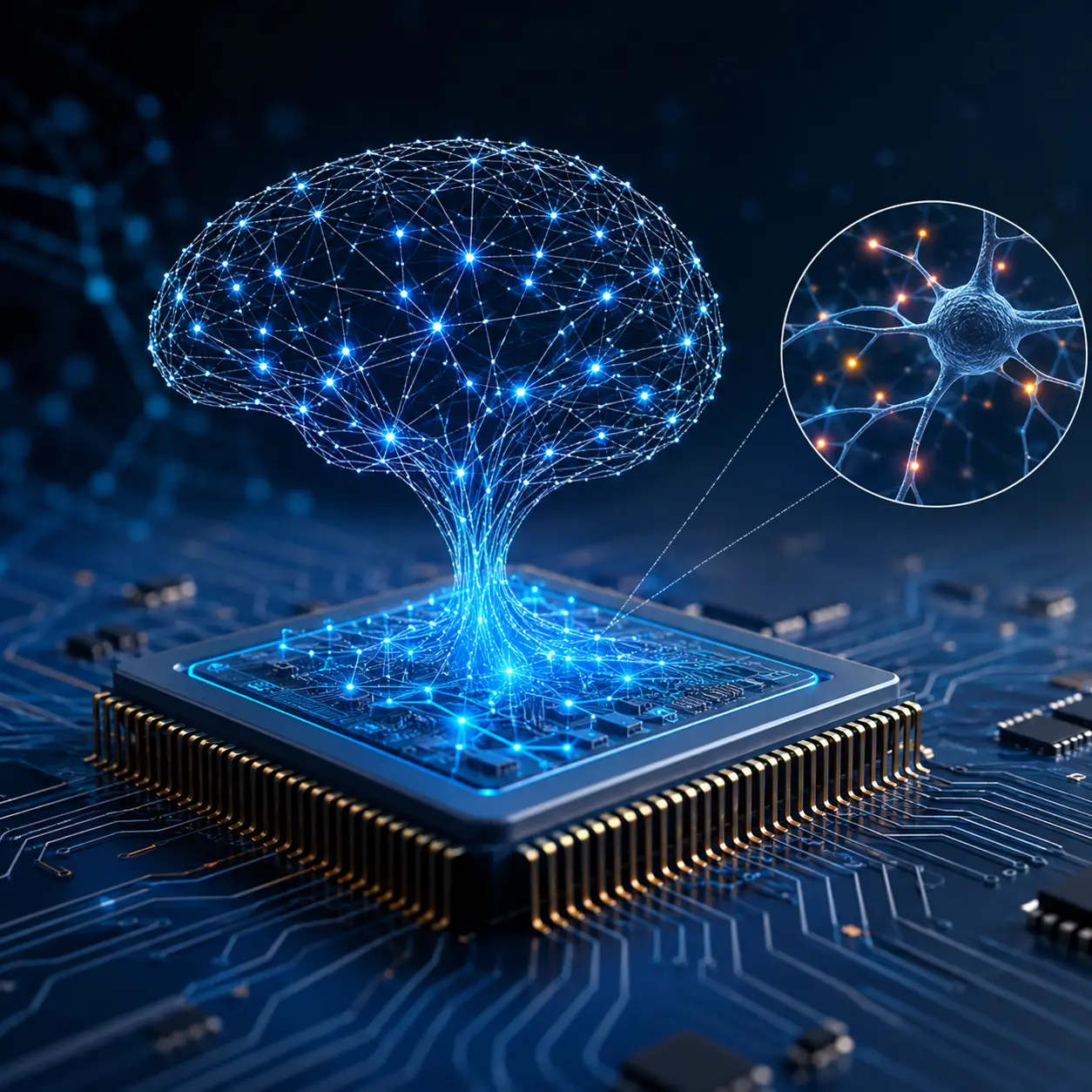
Neuromorphic computing is no longer a concept locked inside research labs. In 2026, brain-inspired chips are stepping out of the lab and into the real world — and they are doing it fast. If you have ever wondered how the human brain runs on just 20 watts while powering everything from complex thoughts to instant reflexes, you are not alone. Scientists and engineers have been asking the same question for decades. Their answer? Build a chip that works like the brain. That is exactly what neuromorphic computing does. And it may be the biggest shift in AI hardware since the GPU took over.
In this article, you will learn what neuromorphic computing is, how a neuromorphic processor works, why the Intel Loihi chip is leading the charge, what spiking neural networks do, and why this technology could reshape the future of AI hardware as we know it.
What Is Neuromorphic Computing?
Neuromorphic computing is a method of building computer chips that mimic the way the human brain processes information. Instead of separating memory and processing like a traditional chip does, a neuromorphic processor places both memory and computation together — just like real neurons and synapses in the brain.
The term was first introduced by scientist Carver Mead in the late 1980s. But in 2026, neuromorphic computing has finally reached a critical turning point, with real systems showing remarkable results in energy efficiency, speed, and real-time learning.
Think of it this way: a GPU works like a power station — it runs full power all the time, handling massive parallel workloads. A brain computer chip works differently. It stays quiet until there is something to process, then fires up only what it needs. That one difference changes everything about how much power it uses.
The Problem With GPUs That Nobody Talks About Enough
GPUs have powered the AI revolution. They are great at doing thousands of calculations at once, which is perfect for training large AI models. But this strength is also their biggest weakness.
Training a single large AI model today can use as much energy as a small town uses in a year. Data centers running these models are projected to consume more electricity than some entire nations by 2028. The heat they generate requires massive cooling systems. The cost is climbing faster than the results.
This is where neuromorphic computing enters the conversation. A traditional AI accelerator keeps all circuits running all the time. A neuromorphic chip only uses power when something happens — like a real neuron firing. That event-driven design is what makes it so dramatically more efficient.
Research has shown that for certain tasks, a neuromorphic processor can achieve up to a 99.5% reduction in energy use compared to a standard GPU. That is not a small improvement. That is a revolution.
How Does a Neuromorphic Processor Actually Work?
At the heart of neuromorphic computing is a concept called the spiking neural network (SNN). Understanding it is key to understanding why this technology is so different.
What Is a Spiking Neural Network?
A spiking neural network is a type of artificial neural network that communicates using short bursts of electrical signals — called spikes — rather than continuous values. This mirrors exactly how biological neurons talk to each other.
In a traditional deep learning model, neurons send floating-point numbers back and forth constantly. In a spiking neural network, a neuron stays silent until its input signals build up to a certain threshold. Only then does it fire a spike and pass the signal forward. This means computation only happens when there is something worth computing.
The result? Massively lower power consumption, real-time learning capability, and faster responses for time-sensitive tasks. A spiking neural network is not just more efficient — it is better suited for the kind of unpredictable, real-world data that streams in from sensors, cameras, and microphones.
The Von Neumann Problem — And Why Brain Computer Chips Solve It
Most processors today follow what is called the von Neumann architecture. In this design, memory and processing are kept in separate physical locations. Every time a calculation needs to happen, data must travel between the two. This back-and-forth is called the von Neumann bottleneck, and it wastes enormous amounts of energy and time.
A brain computer chip eliminates this bottleneck entirely. In neuromorphic systems, memory and processing are co-located — meaning they sit right next to each other on the chip, just like synapses and neurons in the brain. This is also what is known as in-memory computing, and it is one of the most powerful concepts in modern chip design.
In-memory computing allows calculations to happen where the data is stored, rather than moving data to a processor. This reduces energy use, cuts latency, and makes the whole system faster for the types of tasks neuromorphic chips are built for.
Intel Loihi Chip: The Flagship of Neuromorphic Research
When talking about neuromorphic computing in 2026, the Intel Loihi chip is the name that comes up most. Intel has been developing neuromorphic processors since 2017, and the progress has been remarkable.
Loihi and Loihi 2: What Changed?
The original Intel Loihi chip featured 128 neuromorphic cores, 130,000 artificial neurons, and 130 million synapses. It was built on Intel’s 14nm process and was designed as a research platform for spiking neural network development.
Loihi 2 took things much further. It is 10 times faster than its predecessor and packs 15 times greater resource density. Each of its 128 asynchronous neuron cores can host thousands of programmable spiking neuron instances and up to half a million synapses. The chip uses on-chip SRAM for both compute and memory, keeping the data exactly where the processing happens — a perfect example of in-memory computing in action.
Intel also developed the Lava open-source software framework for Loihi 2, allowing developers to build neuromorphic applications without needing deep hardware expertise. This made the Intel Loihi chip ecosystem more accessible and helped grow the research community around it.
Hala Point: The World’s Largest Neuromorphic System
Intel did not stop at a single chip. The Hala Point system, deployed at Sandia National Laboratories, is built from 1,152 Loihi 2 processors and stands as the world’s largest neuromorphic system to date. It contains 1.15 billion neurons and 128 billion synapses, and it achieves energy efficiency exceeding 15 trillion 8-bit operations per second per watt.
That puts Hala Point in a completely different league compared to traditional GPU clusters for specific workloads. It delivers over 10 times more neuron capacity and up to 12 times higher performance than its predecessor system. This is no longer a proof of concept — it is a working, large-scale neuromorphic computing platform.
IBM NorthPole: Another Big Player in the Brain Computer Chip Race
Intel is not working alone. IBM has developed NorthPole, a brain computer chip that takes a slightly different approach. Instead of using spiking neural networks, NorthPole distributes memory across 256 computing cores on the same die, completely eliminating the bottleneck between memory and processor.
The result is an AI accelerator that delivers 25 times better energy efficiency than leading GPUs on image recognition benchmarks. It is designed for edge deployment — places where power budgets are tight, like autonomous drones, medical wearables, and industrial IoT sensors.
IBM describes NorthPole as capable of running AI-based image recognition applications more efficiently and with lower latency than existing chips on the market. That is a bold claim, and the benchmarks back it up.
The Role of Analog AI Chips in Neuromorphic Systems
There is another dimension to neuromorphic computing that often goes unmentioned: the use of analog circuits. A traditional computer chip is digital — everything is either a 0 or a 1. But an analog AI chip works differently. It uses the physical properties of materials to perform mathematical operations, much like how the brain uses chemical and electrical signals.
Analog AI chips can perform certain calculations with far less energy than digital circuits. When combined with in-memory computing architectures, they become even more powerful. Syntiant, a company building analog computation in memory chips, has demonstrated that for tasks like keyword detection, their analog AI chip can run on less than 1 milliwatt of power — a fraction of what any GPU would require for the same task.
This analog approach is increasingly being combined with neuromorphic principles to push energy efficiency even further. It represents a frontier in AI hardware where the laws of physics themselves are being used as a computational tool.
Real-World Applications of Neuromorphic Computing in 2026
Neuromorphic computing is not just a research curiosity anymore. It is showing up in real applications across many industries.
Edge AI and IoT Devices
One of the most exciting use cases is edge AI — running artificial intelligence directly on a device without sending data to the cloud. Neuromorphic processors are perfect for this because they can run complex models on power budgets as low as a few milliwatts. Smart cameras, always-on voice assistants, and industrial sensors can all benefit from a brain computer chip that processes data locally in real time.
In 2026, around 62% of edge AI deployments are now relying on neuromorphic chip designs for faster response times. That number is growing quickly.
Robotics and Autonomous Systems
Robots need to react to the world in real time. They deal with streams of sensor data — touch, vision, sound — that come in unpredictably. A spiking neural network is naturally suited for this. It processes each event as it happens, not in scheduled batches. This means robots powered by neuromorphic processors can respond faster and more efficiently than those running on traditional chips.
Studies have shown that neuromorphic systems can achieve up to 70 times faster performance and 5,600 times greater energy efficiency than GPU-based edge systems for continual learning tasks — a figure that makes a huge difference in battery-powered robotics.
Healthcare and Wearable Technology
Wearable health monitors must run 24/7 on tiny batteries. Neuromorphic chips make this possible by consuming power only when there is something to process. Real-time monitoring of heart rhythms, detecting seizures, or analyzing brainwave patterns are all tasks where a low-power neuromorphic processor could save lives.
Telecommunications and Network Optimization
Intel has already been working with Ericsson Research to use Loihi 2 for developing custom AI models that optimize telecom architecture. The always-on, real-time responsiveness of the Intel Loihi chip makes it well-suited for network management tasks that require instant decision-making across complex systems.
Defense and Aerospace
The use of neuromorphic processors in defense and aerospace AI platforms has risen by 36% in 2026. These environments demand fast, reliable, and low-power decision-making — exactly what neuromorphic computing delivers.
Neuromorphic Computing vs GPU: A Fair Comparison
It is important to be honest here. Neuromorphic computing does not replace GPUs in every situation. For training large language models, running massive parallel computations, and dense matrix operations, GPUs are still the gold standard. Their power comes from doing enormous amounts of math simultaneously, and nothing beats them at that specific task today.
Where neuromorphic computing wins is in inference, edge deployment, real-time sensory processing, and anything where the data is sparse, time-varying, and arrives in irregular bursts. For those workloads, the energy advantage is massive — sometimes 100 times or more efficient.
Think of it like this: a GPU is a freight train — powerful, massive, and built for heavy loads. A neuromorphic processor is a bicycle — not always the fastest, but infinitely more efficient for the right journey. The future of AI hardware almost certainly involves both running together, each handling the tasks they do best.
What Is an AI Accelerator and Where Does Neuromorphic Computing Fit?
An AI accelerator is any chip designed specifically to speed up AI workloads more efficiently than a general-purpose CPU or GPU. TPUs, NPUs, and FPGAs are all examples of AI accelerators. Neuromorphic processors are a newer type of AI accelerator — one that prioritizes energy efficiency and real-time learning over raw computational power.
The AI accelerator market is enormous and growing fast. Neuromorphic computing occupies a specialized but rapidly expanding corner of that market, particularly for edge applications, autonomous systems, and scenarios where low power consumption is non-negotiable.
The Challenges Neuromorphic Computing Still Faces
No technology is perfect, and neuromorphic computing has real challenges that need to be addressed before it goes fully mainstream.
Software ecosystem maturity: Training models for spiking neural networks requires completely different tools than TensorFlow or PyTorch. The ecosystem is still developing, and there are far fewer trained developers in this area compared to traditional deep learning.
Benchmark limitations: Critics point out that spiking neural networks can struggle to match the performance of conventional models on standard benchmarks. For dense, data-heavy workloads like modern large language models, neuromorphic approaches are not yet competitive.
Programming complexity: Writing software for a neuromorphic processor requires understanding both the hardware architecture and the neuroscience-inspired model. This is a steep learning curve for developers coming from conventional AI backgrounds.
Fabrication infrastructure: Building neuromorphic chips at scale requires specialized manufacturing. High R&D costs and limited fabrication infrastructure currently restrict broader participation to well-funded organizations.
Despite these challenges, the trajectory is clear. The software tools are improving rapidly, and the hardware results are too strong to ignore.
The Neuromorphic Computing Market in 2026
The business world is starting to pay serious attention to neuromorphic computing. Multiple market research reports in 2026 point to explosive growth ahead. One forecast projects the neuromorphic chip market will reach $76.18 billion by 2035, up from approximately $4.89 billion in 2025 — a CAGR of 31.6% over that period.
Another report from April 2026 estimates the neuromorphic and brain-inspired AI hardware market generated around $50 million in commercial revenue in 2025, projected to reach $185 million by 2030. While these numbers vary by methodology, the direction is unanimous: rapid, sustained growth driven by edge AI, robotics, and the demand for energy-efficient computing.
Key players in this space include Intel, IBM, Qualcomm, Samsung, BrainChip, and a growing field of startups. North America currently leads with around 40% of the global market share.
The Future of AI Hardware: Where Does Neuromorphic Computing Go From Here?
The future of AI hardware is not a single winner. It is a layered ecosystem where different chip architectures handle different parts of the problem. GPUs will likely remain dominant for data center training for years to come. But at the edge — on phones, robots, drones, sensors, and wearables — neuromorphic computing is positioned to become the default choice.
The next major leap will come from combining neuromorphic architectures with analog AI chip designs, in-memory computing, and advances in materials science. Researchers are already working toward analog neuromorphic circuits that push energy efficiency below the picojoule range — a level that would make always-on AI truly invisible in terms of power consumption.
The spiking neural network software ecosystem is also maturing. Tools like Intel’s Lava framework, along with growing academic and industry investment, are making it easier for developers to build real applications. As that software gap closes, the barrier to adoption will shrink.
We are likely to see neuromorphic chips enter consumer electronics, healthcare wearables, and automotive systems within the next two to three years. The technology is ready. The market is ready. The only thing slowing it down is the natural pace of industrial adoption.
Conclusion: Neuromorphic Computing Is Not Just the Future — It Is Happening Now
Neuromorphic computing is one of the most important technology shifts of this decade. By designing brain computer chips that work the way biological neurons do — using spiking neural networks, in-memory computing, and event-driven processing — engineers are building a new class of AI hardware that is faster, far more energy-efficient, and capable of real-time learning.
The Intel Loihi chip and its massive Hala Point system have proven that neuromorphic processors can scale. IBM’s NorthPole has shown that brain-inspired architecture delivers real gains for edge AI. The analog AI chip approach is pushing efficiency further than anyone thought possible. And the market is responding with billions in investment and rapid commercial expansion.
Neuromorphic computing will not replace GPUs overnight. But for edge AI, robotics, healthcare, and any application where power matters, it is fast becoming the only sensible answer. The brain-inspired chips are here, and they are changing what computing can be.
If you want to stay ahead in AI hardware, neuromorphic computing is the space to watch in 2026 and beyond.