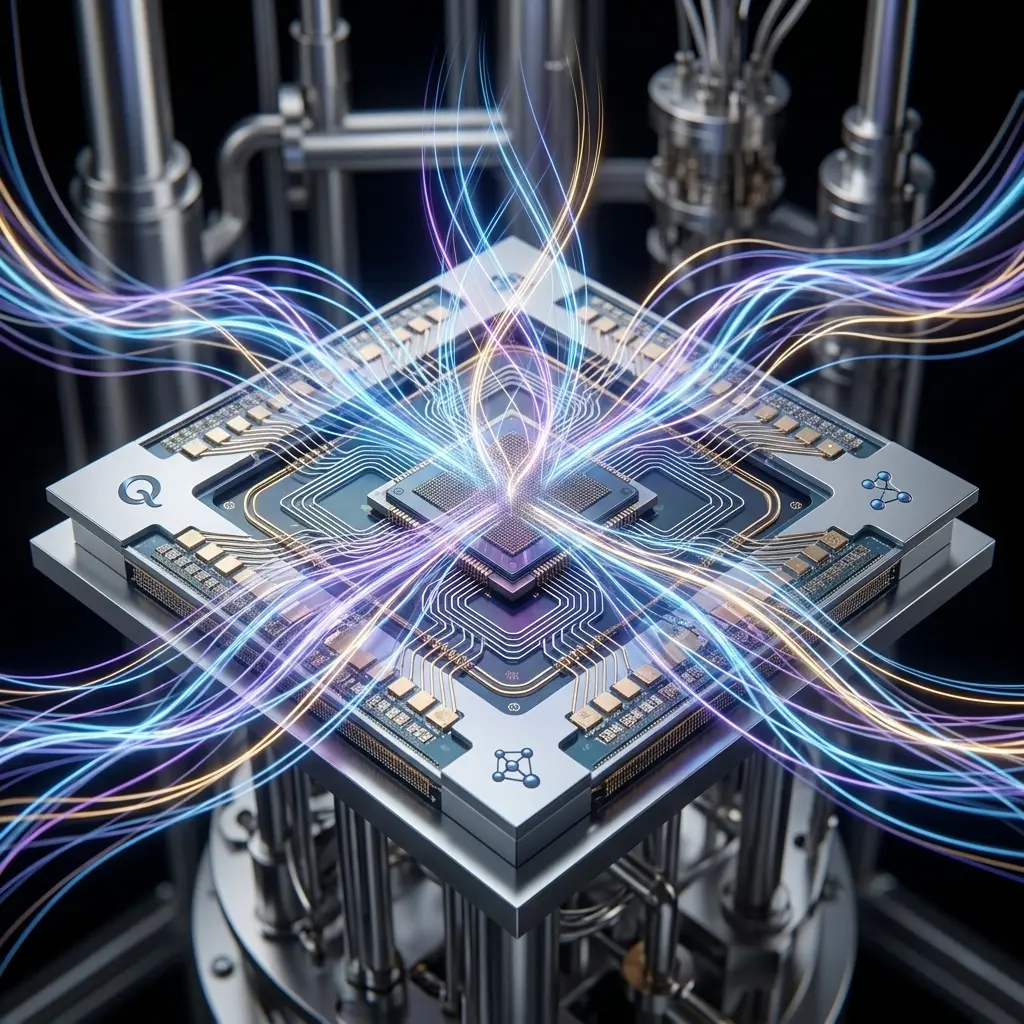
Quantum computing is one of the most exciting and talked-about technologies of our time. But for most people, it still sounds like something out of a science fiction movie. The truth is, quantum computing explained simply is not as complicated as it seems. In this article, you will get a clear, easy-to-understand breakdown of what quantum computing is, how quantum computers work, how they compare to the machines we use today, and what the future of quantum computing looks like in 2026 and beyond. Whether you are a student, a curious reader, or a business professional, this guide is written just for you.
What Is Quantum Computing? A Clear and Simple Definition
At its core, quantum computing is a new type of computing that uses the laws of quantum physics to process information. Regular computers — the ones on your desk or in your pocket — work with “bits.” A bit is the smallest unit of information and can only be either 0 or 1.
Quantum computing explained simply: instead of bits, quantum computers use “qubits” (quantum bits). A qubit can be 0, 1, or both at the same time. This unique ability allows quantum computers to process millions of possibilities all at once, making them incredibly powerful for certain tasks.
Think of it this way. Imagine you are trying to find the exit in a giant maze. A regular computer tries one path at a time. A quantum computer explores all paths at the same time. That is the basic idea behind why quantum computers are so powerful.
According to a report from Singularity Hub published in April 2026, quantum computing harnesses the counterintuitive laws of quantum mechanics — the branch of physics that describes how matter and energy behave at the smallest possible scales.
How Quantum Computers Work: The Core Concepts
To understand how quantum computers work, you need to know three key ideas: superposition, entanglement, and interference. These are the building blocks of all quantum computing.
1. Qubits — The Building Blocks of Quantum Computing
A qubit is the quantum version of a regular bit. While a regular bit is like a light switch — either ON (1) or OFF (0) — a qubit is more like a spinning coin. It can be heads, tails, or in a “spinning” state that is both at the same time.
This “both at the same time” state is what makes how quantum computers work so different from normal computing. By using many qubits together, a quantum computer can represent and process a huge number of combinations simultaneously.
2. Superposition — Being in Two States at Once
Superposition is the ability of a qubit to exist in multiple states at the same time — until it is measured. Once you measure a qubit, it “collapses” into either a 0 or a 1. Before measurement, it holds all possible values at once.
This is one of the most important parts of understanding quantum computing explained simply. It is what gives quantum computers their ability to work through enormous numbers of possibilities in parallel, far beyond what classical machines can achieve.
3. Entanglement — Quantum Connection
Entanglement is a special link between two qubits. When two qubits are “entangled,” the state of one instantly affects the state of the other — no matter how far apart they are. This connection allows quantum computers to coordinate information across many qubits at the same time.
As noted in research published by ScienceDaily in early 2026, quantum systems use both superposition and entanglement to process information “in entirely new ways” that classical systems simply cannot replicate.
4. Quantum Interference — Steering Toward the Right Answer
Interference is the process by which a quantum computer guides its calculations toward correct answers and away from wrong ones. Think of it like noise-canceling headphones — it “cancels out” wrong paths and strengthens the right ones.
Together, these three principles explain the basics of how quantum computers work. They work in harmony to let quantum machines tackle problems that would take a normal computer billions of years to solve.
Quantum vs Classical Computing: What Is the Real Difference?
Understanding quantum vs classical computing helps you see why this technology is such a big deal. Here is a side-by-side comparison in simple terms:
- Data Unit: Classical computers use bits (0 or 1). Quantum computers use qubits (0, 1, or both).
- Processing Style: Classical computers process tasks one step at a time. Quantum computers process many possibilities at once.
- Speed: For complex problems, quantum computers can be exponentially faster. In October 2025, Google demonstrated a 13,000× speedup over the world’s fastest classical supercomputer (Frontier) using just 65 qubits.
- Error Rate: Classical computers are very reliable. Quantum computers are still prone to errors due to qubit instability, though this is rapidly improving in 2026.
- Best Use Cases: Classical computers are better for everyday tasks. Quantum computers shine at optimization, simulation, cryptography, and machine learning.
- Cost and Access: Classical computers are widely available and affordable. Quantum computers are expensive and currently accessed mainly via cloud platforms.
The key takeaway on quantum vs classical computing is this: quantum computers are not a replacement for your laptop. They are specialized tools built to solve problems that are simply too complex for today’s machines.
As experts at IEEE Spectrum explained in February 2026, the goal of the quantum computing industry is to build a powerful machine capable of solving large-scale problems in science and industry that classical computing cannot solve — and real progress is being made toward that goal in 2026.
Real-World Applications of Quantum Computing Today
One of the most exciting parts of quantum computing explained simply is seeing where it is actually being used. Quantum computers are no longer just a lab experiment. They are moving into real industries right now.
Drug Discovery and Healthcare
Designing a new medicine is one of the hardest problems in science. It can take over a decade and billions of dollars to bring a single drug to market. Quantum computers can simulate molecular interactions at the quantum level, helping researchers identify the best drug candidates far faster than classical methods allow.
Pharmaceutical companies are already running pilot programs using quantum simulation to explore protein folding and drug-receptor binding — tasks that would overwhelm even the most powerful classical supercomputers.
Finance and Banking
Banks and investment firms are piloting quantum computing tools for risk modeling, portfolio optimization, and option pricing. The ability to evaluate millions of financial variables at once makes quantum systems ideal for the fast-moving world of financial markets.
Cybersecurity
Quantum vs classical computing becomes especially critical in cybersecurity. Quantum computers can potentially break current encryption methods like RSA. This has pushed governments and companies to develop “post-quantum cryptography” — new security systems that even quantum machines cannot crack.
Quantum Key Distribution (QKD) is another innovation, creating communication channels that are virtually impossible to intercept. In 2026, cybersecurity is one of the fastest-moving application areas for quantum computing.
Logistics and Supply Chain
Companies in logistics use quantum optimization to improve routing, scheduling, and supply chain management. Finding the most efficient route through thousands of variables is a perfect task for a quantum machine.
Energy and Climate Science
Quantum computers are being tested for designing better batteries, modeling clean energy systems, and managing electrical grids more efficiently. These applications could play a major role in addressing the global climate challenge.
Artificial Intelligence
One of the most promising areas is the combination of quantum computing and artificial intelligence. Quantum systems can accelerate AI model training, reduce energy consumption, and process datasets in ways that classical AI hardware cannot match. McKinsey’s 2025 Quantum Technology Monitor confirmed that quantum computing directly addresses AI’s core constraints: algorithmic efficiency, memory limitations, and computing bottlenecks.
The Future of Quantum Computing in 2026 and Beyond
The future of quantum computing has never looked more promising. In 2026, the industry has officially entered what experts call the “fault-tolerant foundation era.” This means that adding more qubits is now starting to reduce errors rather than increase them — a critical turning point.
Here are the most important trends shaping the future of quantum computing right now:
Error Correction Is the Top Priority
The race in 2026 is no longer about who has the most qubits — it is about who has the most reliable ones. Advances in quantum error correction are paving the way for fault-tolerant systems that industries can actually depend on. IBM’s roadmap targets logical qubits with a Kookaburra processor in 2026, while its 2028 Starling processor aims for 200 logical qubits.
Hybrid Quantum-Classical Systems
The near-term future of quantum computing is hybrid. This means combining classical processors with quantum processors to solve specific problems more efficiently. This architecture is already accelerating AI training, reducing energy use, and creating real value in finance, healthcare, and logistics.
Quantum Computing as a Service (QCaaS)
Major technology companies are making quantum computing accessible through cloud platforms. Researchers and businesses can now run quantum experiments without owning a physical quantum machine. This “Quantum Computing as a Service” model is dramatically lowering the barrier to entry.
Government Investment Is Surging
Governments around the world are pouring billions into quantum research. The United States, China, and the European Union are all racing to achieve “quantum supremacy” in their regions. Expert predictions from The Quantum Insider in early 2026 noted a surge in government procurement orders focused on fault-tolerant quantum computers and benchmarking initiatives.
Market Growth Is Explosive
The future of quantum computing is backed by impressive market numbers. According to multiple research reports from early 2026, the global quantum computing market is valued at around $1.96 billion in 2026 and is projected to grow to over $19 billion by 2035, with some forecasts reaching as high as $40 billion. The compound annual growth rate (CAGR) sits between 28% and 36%, depending on the forecast model.
Advantages and Disadvantages of Quantum Computing
Key Advantages
- Unmatched speed for complex problems in chemistry, finance, and AI
- Parallel processing — evaluates millions of solutions at once
- Better optimization — finds the best solution out of enormous possibilities
- Stronger encryption — quantum cryptography is nearly impossible to break
- Accelerates drug discovery — simulates molecules more accurately than any classical computer
Key Disadvantages
- Qubit instability — qubits are very sensitive to temperature, vibration, and noise
- High error rates — current systems still make more mistakes than classical computers
- Extreme operating conditions — most quantum computers need temperatures colder than outer space
- Very high cost — building and maintaining a quantum computer requires massive investment
- Talent shortage — there are not enough trained quantum computing experts in the world
- Limited everyday use — for most common tasks, a classical computer is still faster and more practical
Quantum vs Classical Computing: Why You Should Still Care
You might be wondering: if quantum vs classical computing is so one-sided for everyday tasks, why does it matter to regular people? The answer is simple — the ripple effects of quantum breakthroughs will touch every corner of daily life.
Better medicines, safer communications, smarter AI, cleaner energy — all of these are downstream effects of progress in quantum computing. Even if you never touch a quantum computer yourself, the technology will shape the world you live in.
As researchers from the University of Chicago, MIT, and Stanford wrote in a landmark 2026 paper published in Science, we are at a “transistor moment” in quantum technology — a turning point as significant as the invention of the transistor in classical computing. The foundational physics is established. Functional systems exist. The next step is scaling.
Conclusion: The Quantum Future Is Already Here
We started with a simple question: what is quantum computing? By now, you have a clear picture. Quantum computing explained simply comes down to this: it is a new way to process information using the strange but powerful laws of quantum physics. Instead of bits, it uses qubits. Instead of processing one thing at a time, it processes millions of possibilities at once.
Understanding how quantum computers work — through superposition, entanglement, and interference — shows us why this technology is unlike anything that came before it. The gap between quantum vs classical computing will only grow wider as error correction improves and hybrid systems become standard.
Most importantly, the future of quantum computing is not just a distant promise. In 2026, it is an unfolding reality. Markets are growing at record rates. Industries are running real pilots. Governments are investing billions. The scientists working on this technology are not speculating about what might happen. They are building what comes next.
Whether you are a student, a professional, or simply someone who wants to understand the world better, keeping up with quantum computing is one of the smartest things you can do right now. The quantum age has begun.