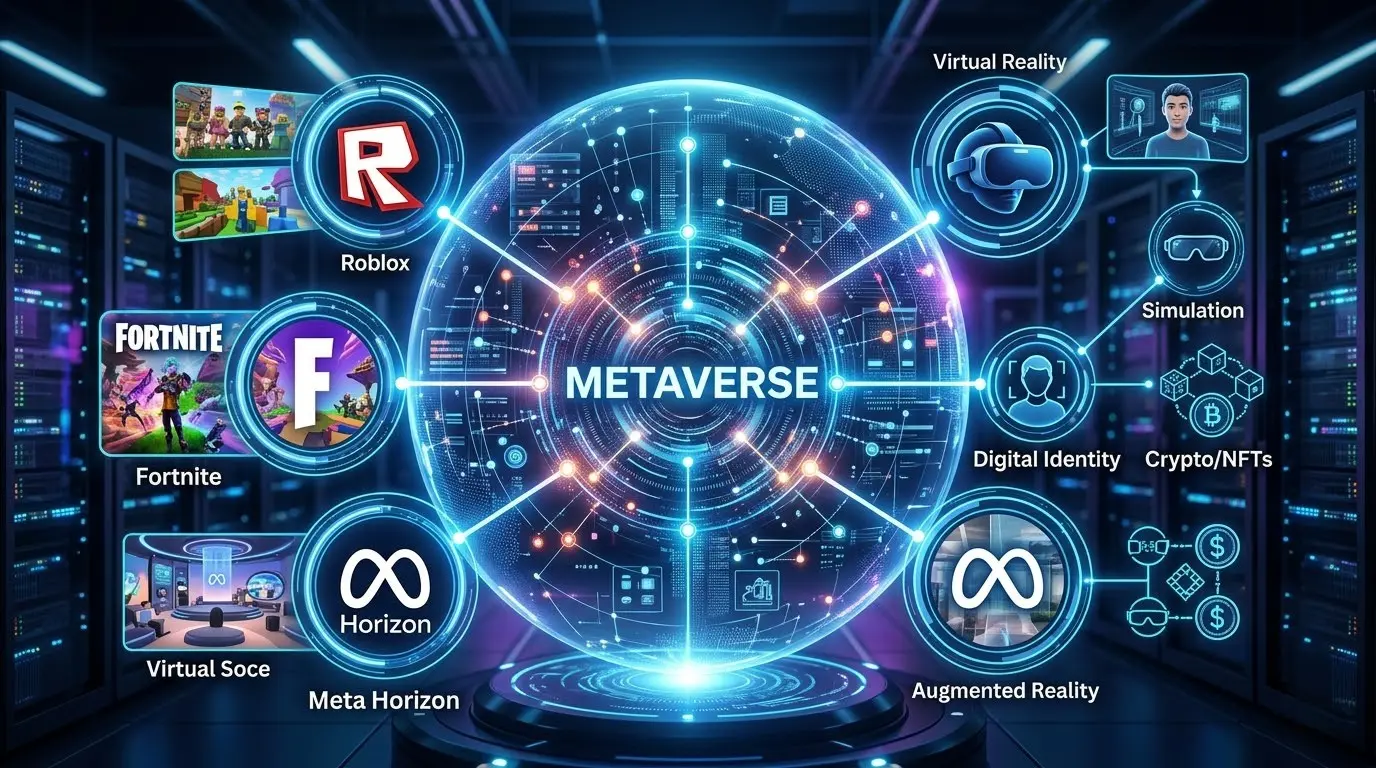
If you have been following tech news in the last few years, you have probably heard the word metaverse a lot. But what is the metaverse, really? Is it just a buzzword that companies used to sell headsets? Or is it something bigger that is quietly changing how we work, play, and connect online? In 2026, these questions matter more than ever. The hype has cooled down, but the technology behind the metaverse is still moving forward — just in ways that most people are not seeing yet. This article breaks it all down in simple, clear language so you can decide for yourself.
What Is the Metaverse? A Simple Definition
The word “metaverse” comes from a 1992 science fiction novel called Snow Crash by Neal Stephenson. In that book, the metaverse was a 3D virtual world where people escaped from their real lives. But in today’s world, the definition has grown much bigger.
At its core, what is the metaverse is a question about a persistent, shared digital space where people can interact, work, play, and build — using avatars, virtual environments, and immersive technology. It is not one single app or platform. It is more like a concept: the next version of the internet, one that is three-dimensional, real-time, and interactive.
Think of it like this: the regular internet lets you browse a website. The metaverse lets you step inside it.
The metaverse combines several technologies together, including virtual reality (VR), augmented reality (AR), blockchain, artificial intelligence (AI), and spatial computing. When these pieces come together, they create experiences that feel more like being somewhere than simply watching a screen.
A Short History: How Did We Get Here?
The modern interest in the metaverse really exploded in 2021. That was the year Facebook rebranded itself as Meta and announced it would invest billions into building a virtual world. It was also the year when NFTs, virtual land sales, and online concerts inside games became major headlines.
Before that, platforms like Roblox, which launched in 2006, and Minecraft, which came out in 2011, were already building early versions of shared virtual worlds. Virtual concerts in Fortnite — like the Travis Scott event that drew over 12 million players at one time — showed the world what shared digital experiences could look like at scale.
Then came the crash. By 2022 and 2023, the crypto market fell, NFT prices dropped, and big companies started pulling back from their metaverse projects. Meta’s own virtual platform, Meta Horizon Worlds, was mocked for having almost no users and cartoon-like graphics. People started asking: is the metaverse actually over?
Is the Metaverse Still Relevant in 2026?
This is one of the biggest questions people search for today. And the honest answer is: yes, is metaverse still relevant — but not in the way it was originally promised.
The grand vision of everyone living inside a single virtual universe has not happened. Probably not yet, and maybe not ever in that exact form. But the technologies that make up the metaverse — immersive platforms, spatial computing, digital economies, and virtual collaboration — are all still growing and finding real uses.
According to Statista, the metaverse market is projected to reach $103.6 billion in 2025 and grow at a compound annual rate of 37.43%, reaching over $507 billion by 2030. Goldman Sachs has estimated its long-term value at an enormous $8 trillion. These are not the numbers of a dead industry. They are the numbers of an industry that is maturing quietly.
The idea that the metaverse is dead comes mostly from disappointed hype. The idea that is metaverse still relevant gets a strong “yes” when you look at what is actually being built — not in consumer entertainment, but in enterprise training, healthcare simulations, industrial design, and gaming ecosystems.
Metaverse vs Virtual Reality: What Is the Difference?
A lot of people confuse the two, so let us clear this up. When you look at metaverse vs virtual reality, they are related but not the same thing.
Virtual reality (VR) is a technology. It is the hardware and software that puts you inside a digital environment using a headset. You put on glasses or a headset, and you see a completely virtual world around you.
The metaverse is an experience and a concept. VR can be one way to access the metaverse, but it is not the only way. You can enter metaverse platforms through your phone, your computer, or a gaming console. The metaverse is the place; VR is one of many doors into it.
Another key difference in metaverse vs virtual reality is that VR can be a solo experience — like watching a VR movie or playing a VR game alone. The metaverse, by definition, is social and persistent. It continues to exist and change even when you log off.
Spatial Computing: The New Language of the Metaverse
One of the biggest shifts in the conversation around the metaverse is the rise of spatial computing. This term is becoming the preferred way tech companies describe what the metaverse actually does on a technical level.
Spatial computing refers to technology that allows users to interact with digital content using real-world movements, gestures, voice commands, and physical space — instead of a flat screen. Apple’s Vision Pro headset is one of the most well-known examples of spatial computing hardware.
Gartner, one of the world’s leading technology research firms, named spatial computing as one of its top trends for 2025. The firm predicts that the spatial computing market will grow from $110 billion in 2023 to a massive $1.7 trillion by 2033. That growth tells you a lot about where the future of metaverse is heading.
Companies like Siemens, Schneider Electric, and ABB are already using spatial computing to create digital twins — virtual copies of real factories, machines, and buildings — so engineers can test and troubleshoot without ever touching real equipment. This is the metaverse at work, even if nobody calls it that.
Web3 and the Decentralized Metaverse
Web3 is another key concept tied to the metaverse. Where the traditional internet (Web2) is controlled by large companies — think Google, Meta, or Amazon — Web3 is built on blockchain technology and is meant to give control back to the users.
In a Web3 metaverse, users can actually own their digital assets. That means virtual land, avatar clothing, in-game items, and digital art can belong to you — not just the platform you bought them on. Platforms like Decentraland and The Sandbox are built on this idea.
However, the Web3 metaverse has faced serious growing pains. When the crypto market collapsed, virtual land prices fell dramatically. Platforms built on Web3 principles still struggle with low user counts compared to traditional gaming platforms. For example, Decentraland has been reported to have only a few thousand daily active users despite massive media attention in 2021 and 2022.
Still, the idea behind Web3 — owning your digital life, carrying your avatar and assets across platforms, and participating in decentralized digital economies — remains a powerful vision for the future of metaverse. The technology is still maturing, and many developers are continuing to build in this space.
Top Metaverse Platforms to Know About in 2026
Understanding metaverse platforms helps you see what the metaverse looks like today. These are not all the same. Some focus on gaming, some on work, and some on building digital economies. Here are the most important ones.
Roblox
Roblox is one of the clearest examples of what the metaverse looks like when it actually works. In the third quarter of 2025, Roblox reported 151.5 million daily active users — a 70% year-on-year increase. Its quarterly revenue hit $1.36 billion, up 48% from the same period the previous year.
Roblox is a platform where users create their own games and experiences, and other users play them. It has a working virtual economy, a strong creator community, and broad appeal across age groups. Brands like Walmart, Nike, and Burberry have launched virtual experiences inside Roblox. Musicians like Laufey and K-pop group aespa have performed virtual concerts there.
Interestingly, Roblox itself rarely uses the word “metaverse” anymore. The company prefers to describe itself as a gaming platform and creator ecosystem. But what it does — a persistent shared world with digital economies, social interaction, and user-created content — is exactly what the metaverse was always supposed to be.
Fortnite Metaverse
The Fortnite metaverse is another great example of how the metaverse is thriving inside gaming. Developed by Epic Games, Fortnite has grown far beyond its original battle royale game format. Today it is a full entertainment platform with virtual concerts, branded experiences, user-made game modes, and a creator economy.
In 2025, Fortnite’s music festival events collaborated with artists like Sabrina Carpenter, Bruno Mars, BLACKPINK member Lisa, and Hatsune Miku — bringing virtual concerts to millions of fans. According to Epic Games CEO Tim Sweeney, around 40% of all Fortnite gameplay time now happens inside third-party created content, not the original game itself.
Epic Games has also been outspoken about building an open metaverse. In November 2025, they announced a partnership with Unity to promote cross-platform interoperability — the idea that users should be able to take their avatars and assets from one platform to another. This is a key step forward for the Fortnite metaverse and for the broader concept of connected digital worlds.
Meta Horizon
Meta Horizon is the most talked-about and perhaps the most controversial metaverse platform. Mark Zuckerberg has invested tens of billions of dollars into this vision, and Meta’s Reality Labs division has reportedly lost over $70 billion in cumulative costs since 2020.
Meta Horizon includes two main products: Horizon Worlds, which is the consumer social platform, and Horizon Workrooms, which is a virtual meeting tool for businesses. Horizon Worlds has struggled badly with user numbers — reports put its monthly active users at fewer than 200,000, a tiny number compared to Roblox or Fortnite.
But Meta Horizon is now making a major pivot. In early 2026, Meta announced it is formally separating Horizon Worlds from its Quest VR headset platform and shifting Horizon Worlds to become a mobile-first experience — putting it in direct competition with Roblox and Fortnite on smartphones. At Meta Connect 2025, the company also unveiled the Horizon Engine, a new game development platform that promises five times more users per world and four times faster performance.
Meta has also sold between 20 to 25 million Quest headsets to date, and the company has more Quest devices on its roadmap according to its CTO. Whether Meta Horizon can compete with more established metaverse platforms remains to be seen, but the investment continues.
The Future of Metaverse: What Is Coming Next?
When looking at the future of metaverse, the picture is much more detailed and exciting than the dead-or-alive debate suggests.
The future of metaverse is being built right now across several industries. Healthcare workers are using VR simulations to train for complex surgeries. Automotive engineers are designing cars inside shared 3D environments. Jet engine manufacturers are using virtual worlds to test how their engines would behave at extreme altitudes and conditions — scenarios that are impossible or too dangerous to test in the real world.
The gaming segment alone is expected to grow from $25.67 billion in 2025 to $137.96 billion by 2030, at a compound annual growth rate of 40%. The number of users in the metaverse market is expected to reach 2.6 billion by 2030, according to Statista. These are not the numbers of something that is dead.
Artificial intelligence is also reshaping the future of metaverse. Generative AI tools are now being used to build virtual environments faster, create more realistic avatars, and design interactive characters that feel more alive. The combination of AI and spatial computing is expected to make metaverse experiences far more accessible and immersive over the next five years.
The future of metaverse will also rely heavily on better hardware. The average price of VR headsets is expected to drop from around $400 to $200, making the technology more affordable for everyday users. Meta’s Ray-Ban smart glasses — which use AI to overlay digital information onto the real world — have already sold over a million units, showing that lightweight wearables may be the most natural entry point for the average person.
Metaverse Platforms: Consumer vs Enterprise
One of the most important distinctions in metaverse platforms today is the split between consumer and enterprise use cases. The two audiences have very different needs, and the best metaverse platforms are starting to specialize.
Consumer metaverse platforms like Roblox, Fortnite, and Meta Horizon focus on entertainment, social connection, gaming, and creator economies. These platforms attract younger users and thrive on user-generated content.
Enterprise metaverse platforms like Nvidia Omniverse, Microsoft Mesh, Siemens’ Immersive Engineering, and Schneider Electric’s industrial metaverse are focused on productivity, training, and design. These platforms are used by engineers, architects, doctors, and factory managers — not teenagers.
According to research, enterprise-focused metaverse platforms are actually seeing the most real-world adoption. Companies that need to solve actual problems — not just have fun — are finding the most value in these tools right now.
Pros and Cons of the Metaverse
Pros
- Immersive experiences: The metaverse enables levels of interaction and presence that flat screens simply cannot match.
- New economic opportunities: Creators, developers, and designers can build businesses inside virtual worlds.
- Better collaboration: Teams across different countries can meet, work, and build together inside virtual spaces.
- Real training value: Industries like healthcare, defense, and manufacturing are using metaverse tools to train safely and cost-effectively.
- Growing market: With billions in investment and a projected $507 billion market by 2030, there are serious career and business opportunities ahead.
Cons
- High entry costs: VR headsets and spatial computing hardware are still expensive for many people.
- Low mass adoption: Most people still do not use the metaverse regularly, and user numbers for social VR platforms remain low.
- Privacy and data risks: Metaverse platforms collect enormous amounts of user data, including biometric data from headsets.
- Fragmentation: There is no single, open metaverse. Platforms are mostly walled gardens that do not talk to each other.
- Unproven Web3 economy: Digital land and NFT-based assets have lost value dramatically, raising questions about the stability of virtual economies.
Metaverse vs Virtual Reality: Which One Should You Care About?
If you are a regular consumer, the clearest version of the metaverse you will experience today is probably Roblox, Fortnite, or a mobile AR experience. Full-scale metaverse vs virtual reality comparisons often confuse people into thinking you need an expensive headset to participate. You do not — at least not yet.
If you are a business leader or developer, the metaverse vs virtual reality question matters more from an investment perspective. VR hardware is improving fast, prices are dropping, and enterprise tools are already delivering measurable results. The question is not whether to pay attention to these technologies, but when and how to invest in them.
The bottom line on metaverse vs virtual reality is simple: VR is a tool, and the metaverse is the destination that tool helps you reach.
Conclusion: What Is the Metaverse Today — and Should You Pay Attention?
So, what is the metaverse in 2026? It is not the sci-fi world that tech companies promised in 2021. It is not a ghost town either. It is a collection of evolving technologies — spatial computing, gaming platforms, Web3 infrastructure, virtual collaboration tools, and AI-powered environments — that are quietly reshaping how people work, learn, and play.
The future of metaverse is not one big virtual universe that everyone logs into. It is hundreds of smaller, more practical applications that blend digital and physical life in ways that are actually useful. Roblox doing it through games. Fortnite doing it through entertainment. Microsoft and Siemens doing it through industry. And Meta Horizon doing it through its ambitious, expensive, and still uncertain bet on social VR and mobile.
Is metaverse still relevant? Absolutely yes. The market is growing, the technology is maturing, and the companies building it are not going away. If anything, the metaverse is just getting started — just not in the way anyone expected.
Whether you are a gamer, a student, a business professional, or just a curious person, now is a great time to start paying attention to metaverse platforms, spatial computing, and Web3. The digital world is getting bigger, richer, and more immersive every year — and understanding what is the metaverse puts you ahead of the curve.