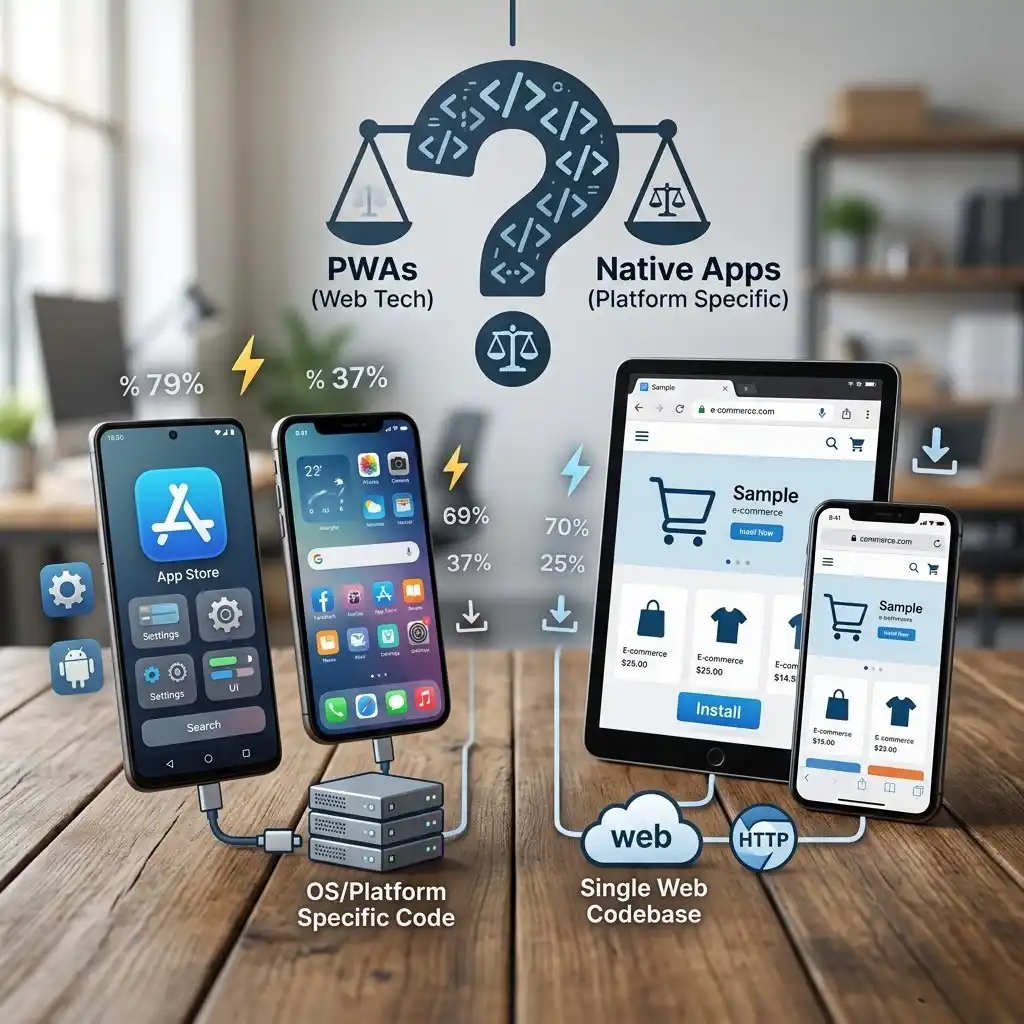
Every business owner, startup founder, and developer faces a critical choice at some point: should you build a progressive web app vs native app? This single decision can shape your product’s future, affect your budget, and determine how millions of users experience your brand. In 2026, this debate is more alive than ever — and more important to get right.
The good news? Both options have grown stronger. PWAs have matured beyond recognition, and native apps continue to push boundaries in performance and hardware access. Whether you are asking yourself should I build a PWA or leaning toward a fully native solution, this guide will help you make a smart, data-backed decision.
We will break down everything — definitions, real-world examples, cost comparisons, web app performance benchmarks, pros and cons, and a clear recommendation based on your specific needs. Let us get started.
What Is a Progressive Web App (PWA)?
A Progressive Web App is a type of web application built using standard web technologies — HTML, CSS, and JavaScript. However, it looks and behaves like a mobile app. Users can install it on their home screen, receive push notifications, and even use it offline — all without downloading anything from an app store.
The magic behind PWAs comes from something called Service Workers. These are background scripts that cache content, enable offline access, and manage push notifications. Combined with a Web App Manifest, they transform an ordinary website into a powerful, app-like experience.
As of today, service workers are supported by nearly 87% of all internet users and virtually every major browser. That is massive reach — and one of the key benefits of PWA technology.
Popular Examples of PWAs
- Starbucks: Their PWA is just 233KB in size — compared to 148MB for their native iOS app. It allows full ordering even without an internet connection.
- Twitter Lite: After launching its PWA, Twitter reported a 75% increase in tweets sent and a 20% decrease in bounce rate.
- Tinder: The Tinder PWA cut loading time in half and reduced its size from 30MB to just 2.8MB. Session time and engagement improved significantly.
- Pinterest: Pinterest users spent 40% more time on the PWA version compared to the old mobile website, leading to a 44% increase in core engagement.
What Is a Native App?
A native app is a software application built specifically for one operating system — either iOS or Android. Developers write iOS apps in Swift or Objective-C, and Android apps in Kotlin or Java. These apps are distributed through official stores like the Apple App Store or Google Play.
Because native apps are compiled directly for the platform they run on, they can access device hardware fully — camera, GPS, Bluetooth, biometric sensors, and more. This makes them the go-to choice when raw power and deep integration matter most.
Popular Examples of Native Apps
- Mobile banking apps like those from JPMorgan or HDFC Bank
- High-performance mobile games like Call of Duty: Mobile
- Augmented Reality apps like IKEA Place
- Healthcare apps with real-time monitoring features
PWA vs Native Mobile App: A Head-to-Head Comparison
Understanding the differences between a PWA vs native mobile app is crucial before you commit to a development path. Let us compare them across the most important factors.
1. Development Cost
One of the biggest benefits of PWA is cost efficiency. PWAs use a single codebase that works across all platforms — iOS, Android, desktops, and tablets. You build once, and it runs everywhere. According to industry data, PWAs can cut development costs by 30 to 50 percent compared to building separate native apps.
Native apps require separate development for iOS and Android. That means two codebases, two teams, and double the maintenance costs. While cross-platform tools like Flutter and React Native help reduce this gap, they still do not fully match the cost efficiency of a PWA.
2. Web App Performance
This is where the comparison gets interesting. Web app performance in PWAs has improved dramatically, but native apps still have a technical edge in specific scenarios.
A 2026 industry report found that for typical business applications, the user experience gap between PWAs and native apps has shrunk to less than 10% for well-optimized builds. Users rarely notice performance differences under 100ms. However, for compute-heavy use cases — such as 3D gaming, augmented reality, or real-time video processing — native apps remain the clear winner.
PWA web app performance shines in one specific area: load time. Thanks to Service Worker caching, repeat visits to a PWA are nearly instant. The app shell loads directly from cache, skipping network latency entirely. For initial discovery, there is also zero app store friction. Meanwhile, native apps require download and installation — which can take minutes before a user can do anything.
3. Offline Capabilities
Both options support offline use, but with different levels of depth. Native apps offer more robust, full-featured offline experiences. PWAs can cache content and support key offline interactions, but complex transactions or real-time data sync may be limited.
A great example of PWA offline success is Konga, a leading Nigerian e-commerce platform. Struggling with users on 2G networks, they built a PWA that reduced data usage for the first load by 92 percent. That is a life-changing improvement for users in low-connectivity regions.
4. Device Hardware Access
In the PWA vs native mobile app debate, hardware access is where native apps shine. Native apps can fully access the camera, GPS, accelerometer, Bluetooth, NFC, biometric authentication, and more without restrictions.
PWAs have improved here through browser APIs (part of Google’s Project Fugu initiative), but access is still more limited. You can use the camera and basic sensors, but advanced integrations like NFC payments or custom Bluetooth peripherals still require native development.
5. App Store Distribution
Native apps are distributed through the Apple App Store and Google Play. This gives them credibility and exposure to billions of users who search these marketplaces daily.
PWAs bypass app stores entirely. You share a URL, and users can install the app directly to their home screen with a single tap. While this removes the friction of store approval, it also means losing visibility in marketplace searches.
That said, Google Play now supports PWA listings, and the line between web and native distribution is blurring fast.
6. SEO and Discoverability
This is a major advantage when comparing PWA vs native mobile app for content-driven businesses. PWAs are indexed by Google just like regular websites. You can apply full SEO optimization — metadata, structured data, backlinks, page speed — to grow organic traffic.
Native apps are not indexed by search engines. Their discoverability depends entirely on app store optimization (ASO) and paid marketing, which is a very different and often more expensive game.
Key Benefits of PWA in 2026
If you are still asking yourself should I build a PWA, here is a clear list of the top benefits of PWA that make it such a compelling choice for many businesses today.
- Single codebase: One development effort covers all devices and platforms.
- Lower cost: 30–50% cheaper to build and maintain compared to native alternatives.
- Instant updates: No app store approval needed. Push updates go live immediately for all users.
- SEO-friendly: Fully indexable by search engines, driving organic traffic.
- No installation barrier: Users can access your PWA via a link — no download required.
- Lightweight: PWAs take up far less storage. The Starbucks PWA is 99.84% smaller than their iOS app.
- Offline access: Service workers enable key functionality without an internet connection.
- Push notifications: Re-engage users with timely, personalized alerts — just like native apps.
- Faster load times: Google reports a 15x improvement in load speed over traditional mobile websites for companies using PWAs.
Real numbers back up these benefits of PWA. AliExpress saw a 104% increase in conversions after switching to a PWA. Forbes saw a 12% increase in readership after their PWA reduced load time from 6.5 seconds to near-instant. Flipkart’s PWA drove a 70% increase in conversions using machine-learning-powered recommendations.
Key Benefits of Native Apps in 2026
Before you fully commit to PWA, it is important to understand what you might be giving up. Here is why native apps remain the right answer for many products.
- Maximum web app performance: Direct access to system APIs means faster computations, smoother animations, and lower latency.
- Full hardware integration: GPS, camera, Bluetooth, NFC, biometrics — all work seamlessly.
- Superior UX/UI: Native apps follow platform design guidelines, delivering polished, familiar interactions.
- Better security: Deeper OS-level access enables stronger encryption and secure authentication flows.
- Monetization tools: In-app purchases, subscriptions, and platform-specific payment systems are deeply integrated.
- AI and AR ready: Frameworks like CoreML, ARKit, and TensorFlow Lite enable advanced experiences unique to native platforms.
- Higher user engagement: Studies show native apps engage users 3x more than web-based alternatives on average.
Should I Build a PWA? Key Questions to Answer First
If you are trying to decide should I build a PWA, the answer depends entirely on your product’s purpose, audience, and technical needs. Here are the questions that will guide your decision.
Choose a PWA if you can answer YES to these:
- Is your app content-heavy — such as news, e-commerce, education, or media?
- Do you have budget constraints and need to launch quickly?
- Is organic search traffic important to your growth strategy?
- Do you want to reach users in emerging markets or low-bandwidth areas?
- Is cross-platform reach more important than cutting-edge device features?
- Do you want to avoid the complexity of managing two separate codebases?
Choose a Native App if you can answer YES to these:
- Does your app rely heavily on device hardware — AR, VR, biometrics, Bluetooth?
- Are you building a game, real-time financial tool, or healthcare monitor?
- Is immersive, polished UX your top priority?
- Do you need advanced offline features beyond basic content caching?
- Is in-app monetization central to your revenue model?
- Are your users primarily loyal, repeat users who will invest in downloading your app?
If you said yes to both columns — a hybrid or cross-platform approach using React Native or Flutter may be your smartest middle ground. These frameworks are maturing fast and can reduce costs by 30–40% while delivering near-native performance.
Web App Performance: How Close Has the Gap Become?
Web app performance is the topic that matters most to developers and product managers. Here is where things stand in 2026.
For most business applications — e-commerce, content platforms, productivity tools, dashboards — a well-optimized PWA delivers web app performance that users genuinely cannot tell apart from native. The performance gap is now under 10% for typical use cases, according to a 2026 industry benchmark report.
Where native still wins in web app performance:
- Complex 3D graphics and game rendering
- Augmented reality experiences
- Heavy background processing and machine learning inference
- Low-latency audio processing
Where PWA wins in web app performance:
- First-load discovery speed (no installation required)
- Repeat-visit load time (Service Worker caching)
- Lightweight footprint on devices
- Battery and data efficiency on low-end devices
The Weather Channel PWA achieved an 80% improvement in load time, demonstrating what focused web app performance optimization can achieve. Meanwhile, companies deploying PWAs report an average 68% increase in mobile traffic, according to Google’s own data.
The Market Is Growing Fast — And Businesses Are Taking Notice
The numbers tell a clear story. The global PWA market was valued at $3.53 billion in 2024 and is projected to reach $21.44 billion by 2033, growing at a compound annual growth rate of nearly 19%. Businesses are shifting toward PWAs because of lower development costs and measurably better user engagement compared to basic mobile websites.
Apple’s Safari — historically the biggest barrier to PWA adoption on iOS — has significantly improved its service worker and web push support since iOS 16.4. This shift has made the progressive web app vs native app question a genuinely competitive conversation for the first time on Apple devices.
When you compare PWA vs native mobile app options purely from a market momentum perspective, PWA adoption is clearly accelerating. But native development is not slowing down either — especially with Kotlin Multiplatform and SwiftUI making cross-platform native development more efficient than ever.
PWA vs Native Mobile App: Quick Decision Summary
| Factor | Progressive Web App (PWA) | Native App |
|---|---|---|
| Development Cost | 30–50% cheaper (single codebase) | Higher (separate iOS + Android builds) |
| Web App Performance | Excellent for content apps, <10% gap | Best-in-class for compute-heavy apps |
| Offline Capability | Good (Service Workers) | Full and robust |
| Device Hardware Access | Limited but growing | Full and unrestricted |
| SEO / Discoverability | Excellent (indexed by Google) | App store only |
| App Store Listing | Optional (via Google Play) | Required (iOS + Android stores) |
| Update Speed | Instant, no review process | Requires store approval |
| Best For | E-commerce, media, startups, content | Gaming, fintech, healthcare, AR/VR |
Conclusion: Progressive Web App vs Native App — The Verdict
The progressive web app vs native app question does not have a single right answer — and that is actually great news for builders in 2026. You have more options, more data, and more tools than ever before to make the right call for your product.
Here is the bottom line: if you are a startup, a content platform, an e-commerce store, or a budget-conscious business targeting broad reach, the benefits of PWA are hard to ignore. Lower cost, faster deployment, SEO-friendly architecture, and impressive real-world results make PWAs a first-choice for most web-first products.
If your product demands high-end web app performance, deep device integration, complex offline behavior, or immersive user experiences — go native. The additional investment pays off in retention, engagement, and capability.
And if you are still unsure whether you should I build a PWA or a native app, start with a PWA. It is faster to validate, cheaper to build, and easier to iterate. You can always add a native app later once your user base and revenue justify it.
In the PWA vs native mobile app debate, the winner is not a technology — it is the business that picks the right tool for the right job. Use the insights in this guide, align your choice with your users’ real needs, and build something that creates genuine value.